Non-Surgical Hair Loss Treatments vs. Transplants: Do You Need Surgery Yet?
When you first notice visible thinning or a receding hairline, navigating the world of hair restoration can feel overwhelming. The medical market offers a vast array of solutions, split into two primary paths: non-surgical therapies designed to preserve hair, and surgical transplants designed to permanently move hair.
Knowing whether it is time to invest in a hair transplant or if non-surgical options are more appropriate depends on the current stage of your hair loss, your age, and your long-term goals.
Understanding Non-Surgical Hair Loss Treatments
Non-Surgical treatments are preventative and therapeutic. They do not create new hair follicles; instead, they work to slow down active shedding, thicken miniaturized hairs, and stabilize the scalp environment.
The primary clinical non-surgical treatments include:
-
- 5-Alpha Reductase Inhibitors (Finasteride): A prescription medication that blocks the conversion of testosterone into Dihydrotestosterone (DHT), the primary hormone responsible for male pattern baldness. It stabilizes thinning across the crown and mid-scalp.
-
- Topical and Oral Vasodilators (Minoxidil): An over-the-counter or prescription treatment that widens blood vessels around the hair follicles. This increases the flow of oxygen and nutrients to the roots, extending the active growth phase of the hair.
-
- Platelet-Rich Plasma (PRP) and Growth Factor Concentrate (GFC): Therapeutic injections that utilize growth factors extracted from your own blood. These factors are micro-injected into the scalp to stimulate cellular repair, reduce inflammation, and strengthen weak follicles.
Understanding Surgical Hair Transplants
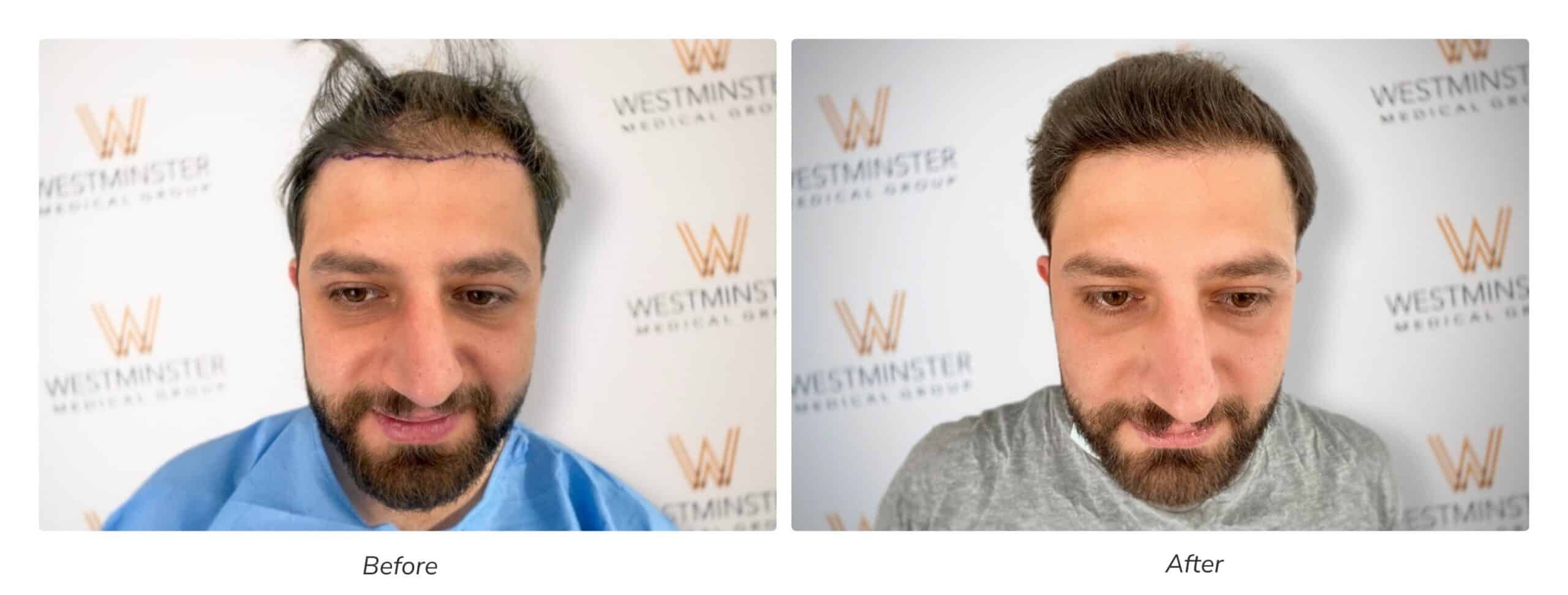
A hair transplant is a definitive, structural procedure. It is designed to address areas where hair follicles have completely miniaturized and stopped growing hair entirely (such as a smooth, receded hairline or an open crown).
Using advanced techniques like Follicular Unit Extraction (FUE) or Direct Hair Implantation (DHI), a surgeon harvests permanent, DHT-resistant hair roots from the back of the head and redistributes them to bald zones.
Comparing Your Options: Do You Need Surgery Yet?
To determine which path aligns with your current condition, consider how these approaches compare across key diagnostic metrics:
-
- The Condition of the Hair Follicle
If your hair is simply thinning, weak, or losing caliber, non-surgical medical treatments can often revitalize the existing root. However, if the hair follicle has been inactive for years and the skin is completely smooth, non-surgical options will not bring it back. In this scenario, a transplant is required to restore coverage.
- The Condition of the Hair Follicle
-
- Your Age and Hair Loss Stability
If you are under the age of 25 and experiencing early thinning, undergoing surgery immediately is rarely advised. Your hair loss pattern is not yet stable, and operating too early can leave you with an unnatural look if your native hair continues to recede behind the new grafts. The primary goal should be stabilizing your hair loss using medical therapies first.
- Your Age and Hair Loss Stability
-
- Long-Term Maintenance Requirements
Non-surgical treatments require ongoing commitment; if you stop taking Finasteride or using Minoxidil, any hair preserved by those treatments will gradually shed. A hair transplant, however, utilizes permanent donor roots that grow naturally for a lifetime, though you may still choose to use non-surgical treatments to protect your remaining native hair.
- Long-Term Maintenance Requirements
The Integrated Approach at WMG London
At WMG London, we do not view non-surgical options and surgical hair transplants as mutually exclusive. In fact, the most successful long-term restorations combine both paths.
Our central London clinic uses high-definition digital trichoscopy to measure your exact rate of hair miniaturization. If surgery is required, our medical team utilizes advanced, low-trauma extraction systems like the WAW DUO and UGraft Zeus. These specialized tools protect your permanent donor hair during harvesting, ensuring high graft survival rates and natural-looking density.
If surgery is premature, we design a customized medical management plan to stabilize and thicken your natural hair safely.
Discover Your Ideal Treatment Path
The most effective way to determine whether you need non-surgical therapy or a definitive transplant is through an anatomical scalp assessment.
Ready for an honest, data-driven evaluation of your hair loss? Submit your photos through the WMG London Online Assessment Suite or book a comprehensive diagnostic consultation at our central London clinic today.